

Most AI tools do one thing: they answer a question, or they execute a command. SEnuke AI is positioning itself as something different a system that tells you what your business should do next, then helps you get it done, with a human still in the approval seat. That’s a bold claim for a name that’s been circulating in the marketing world since the late 2000s.
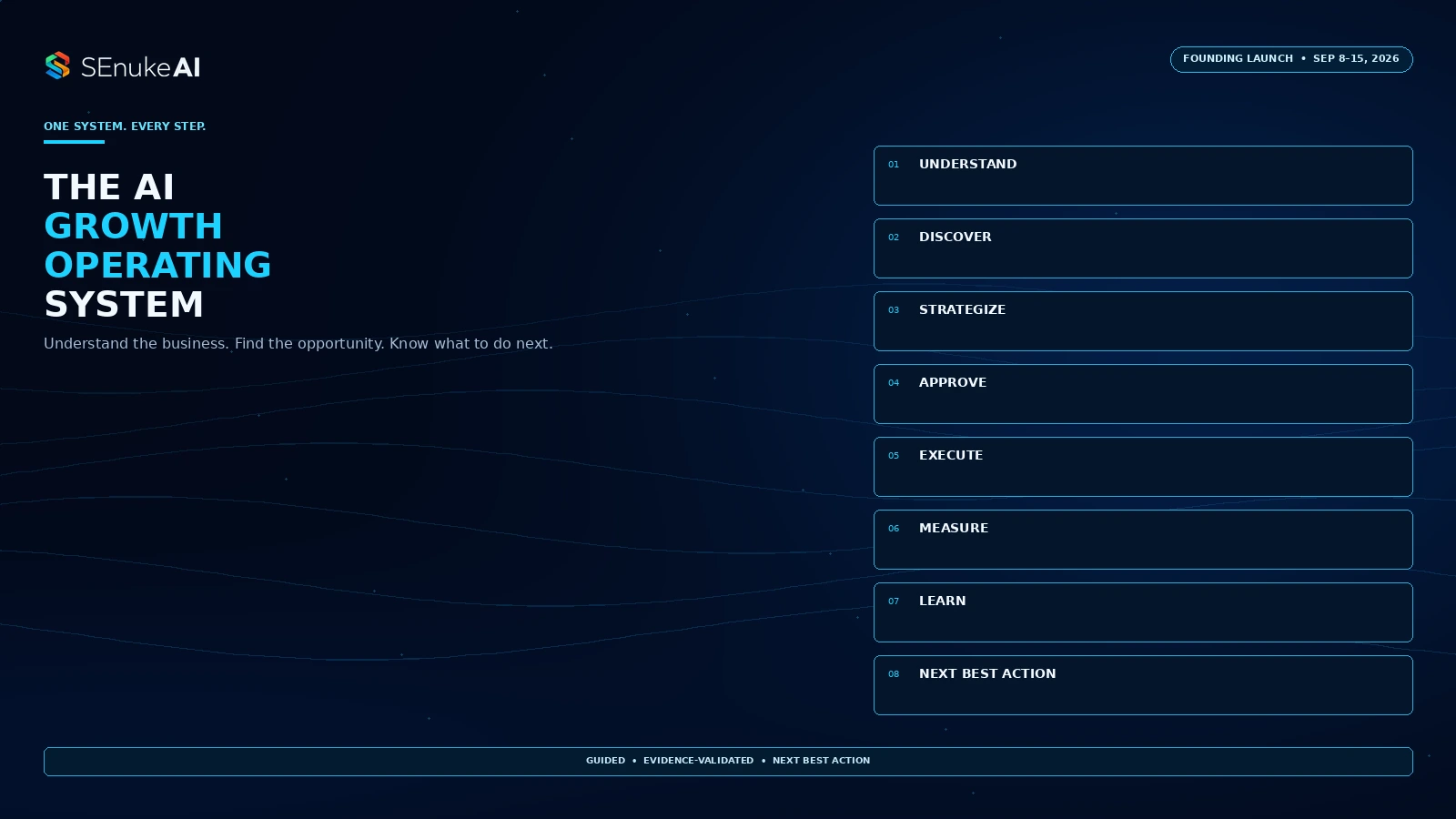
If the name SEnuke rings a bell, it should—it’s one of the earliest well-known all-in-one SEO automation brands, originally built by Joe Russell, who’s been working online full-time since 1999. SEnuke AI is his rebuild of that brand for the AI era, and it’s launching under a very different premise than the old link-building software: rather than automating one task, it’s pitched as “THE AI GROWTH OPERATING SYSTEM”—a connected loop of business understanding, opportunity discovery, strategy, approved execution, measurement, and a recommended “Next Best Action,” repeating continuously.
In this SEnuke AI review, I’ll walk through what’s actually included at each pricing tier, who each plan is realistically built for (solo entrepreneurs, small businesses, or agencies), what the platform does and does not automate, and whether the Founding Launch pricing is worth locking in before the September 15, 2026 deadline. If you’re comparing your options before committing, it’s worth seeing how SEnuke AI stacks up against the rest of our best AI marketing tools 2026 roundup first.
A quick transparency note: this review is based on SEnuke AI’s official Founding Launch Partner materials, product screenshots, and sales page—the platform has not yet been independently tested at the time of writing, since public launch is scheduled for September 8, 2026. I’ll update this review with hands-on impressions once broader access is available. If you’re evaluating this pre-launch, treat the feature descriptions below as what’s promised rather than independently verified performance.
Product Info
| Product Name | SEnuke AI |
| Creator | Joe Russell |
| Launch Date | September 8, 2026, 12:00 PM ET |
| Founding Launch Ends | September 15, 2026, 11:59 PM ET |
| Front-End Price | $79/mo (Entrepreneur) – $497/mo (Agency) |
| Payment Type | Recurring subscription (monthly or annual) |
| Niche | AI Growth / Marketing Operating System |
| Support | Not publicly listed — check official sales page |
| Recommended For | Entrepreneurs, small businesses, agencies |
| Refund Policy | Not specified in Founding Launch brief — verify on sales page |
| Sales Page | Click Here to Get SEnuke AI |
What Is SEnuke AI?
What It Is
SEnuke AI describes itself as a guided AI growth operating system a platform that studies a business, surfaces and ranks growth opportunities, builds out a strategy, helps prepare and carry out approved work, measures the results, and then recommends what to do next based on that evidence. The company is explicit that this is not a chatbot you prompt and not an autonomous agent making unsupervised changes to your business—important actions like publishing or outreach stay behind a human approval step, governed by workspace roles and permissions.
It’s also not positioned purely as an SEO tool, despite the SEnuke name’s SEO-automation roots. SEO and keyword intelligence are one component inside a broader system that also covers content, website guidance, lead magnets, social media, and e-commerce.
Creator & Company Info
SEnuke AI is created by Joe Russell, a JVZoo seller who has been active in the online marketing space since 1999 and built the original SEnuke SEO automation software—a brand with a long track record in that niche (JVZoo lists 7,000+ product sales under his seller account). SEnuke AI is described by the company as a full rebuild of that brand rather than a simple relaunch of the old link-building tool.
Primary Purpose & Problem It Solves
The pitch centers on a specific frustration: most businesses today aren’t short on AI tools—they’re short on a system that connects them. According to the company, most AI tools generate more output (more reports, more content, and more suggestions) but still leave the business owner to manually connect the dots, judge priorities, and decide what to actually do next. SEnuke AI’s answer is what it calls the Continuous Growth Loop:
Understand → Discover → Strategize → Approve → Execute → Measure → Learn → Next Best Action → Repeat
Every plan includes the same core loop—business discovery and a persistent “business brain,” opportunity/keyword/market/competitor intelligence, site/SEO/local/AI-visibility intelligence, strategy and execution plan generation with approvals, guided content/website/social/e-commerce execution support, and ongoing measurement and reporting.
SEnuke AI Pricing (Founding Launch)
| Plan | Monthly | Annual | AI Capacity/mo | Seats |
|---|---|---|---|---|
| Entrepreneur | $79 | $790 (12 months for the price of 10) | 2,000 | Owner only (1 seat) |
| Business | $147 | $1,470 (12 months for the price of 10) | 5,000 (shared) | Owner + 1 team member (2 seats) |
| Agency | $497 | $4,970 (12 months for the price of 10) | 18,000 (shared) | Owner + 2 team members (3 internal seats) + separate Agency Client Viewers |
Founding launch pricing is protected for as long as the subscription stays continuously active and in good standing—meaning current pricing isn’t locked in permanently if you cancel and re-subscribe later.
Access Details
SEnuke AI is sold through JVZoo. The public launch opens September 8, 2026, at 12:00 PM ET, and the Founding Launch pricing window closes September 15, 2026, at 11:59 PM ET. It’s a recurring subscription (monthly or annual), not a one-time purchase—worth flagging clearly since a lot of launch-based software in this space is sold as a single payment.
👉Check out SEnuke AI’s founding launch pricing here
SEnuke AI Key Features
1. Business Discovery & the Business Brain
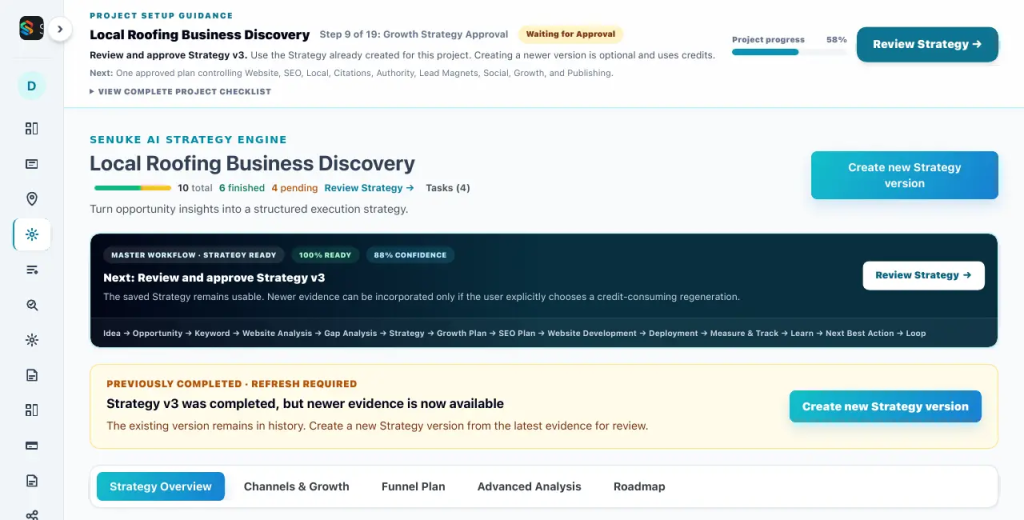
What it does: Before recommending anything, SEnuke AI runs a guided business discovery process to build what it calls a “business brain”—a persistent, verified understanding of the business that every later strategy and recommendation is checked against.
Benefits: This is the mechanism behind the platform’s core differentiator: rather than generating generic suggestions, recommendations are meant to be evaluated against your specific, stored business context rather than reset with every new prompt.
Limitations: The quality of every downstream recommendation depends on how completely and accurately this discovery step is filled in—a guided system still needs accurate input to produce a useful business brain.
Use case: A local roofing company discovery project (shown in the platform’s own screenshots) builds a business brain and strategy specific to residential and light commercial roofing—not a generic “home services” template.
2. Opportunity, Keyword & Competitor Intelligence
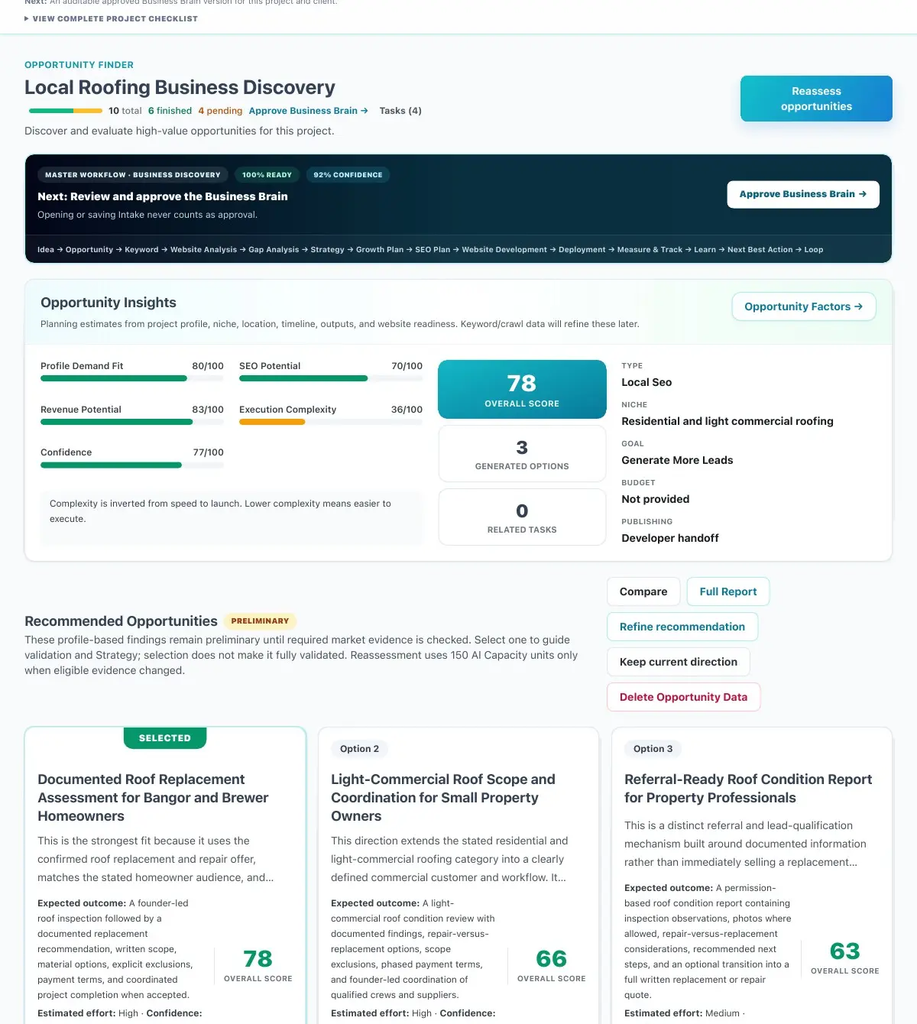
What it does: The platform scores and surfaces growth opportunities — in one screenshot, a “78/100 Opportunity Score” for a local roofing business — alongside dedicated keyword intelligence that reports demand, difficulty, CPC, and SERP opportunity for approved keyword groups.
Benefits: Instead of separate keyword-research and competitor-research tools, this intelligence layer is tied directly back to the same business brain, so opportunities are prioritized in the context of what the specific business can realistically act on.
Limitations: SEnuke AI is explicit that it does not guarantee that every recommendation will be correct or that any outcome (rankings, traffic, or sales) is guaranteed—opportunity scoring is a prioritization aid, not a promise of results.
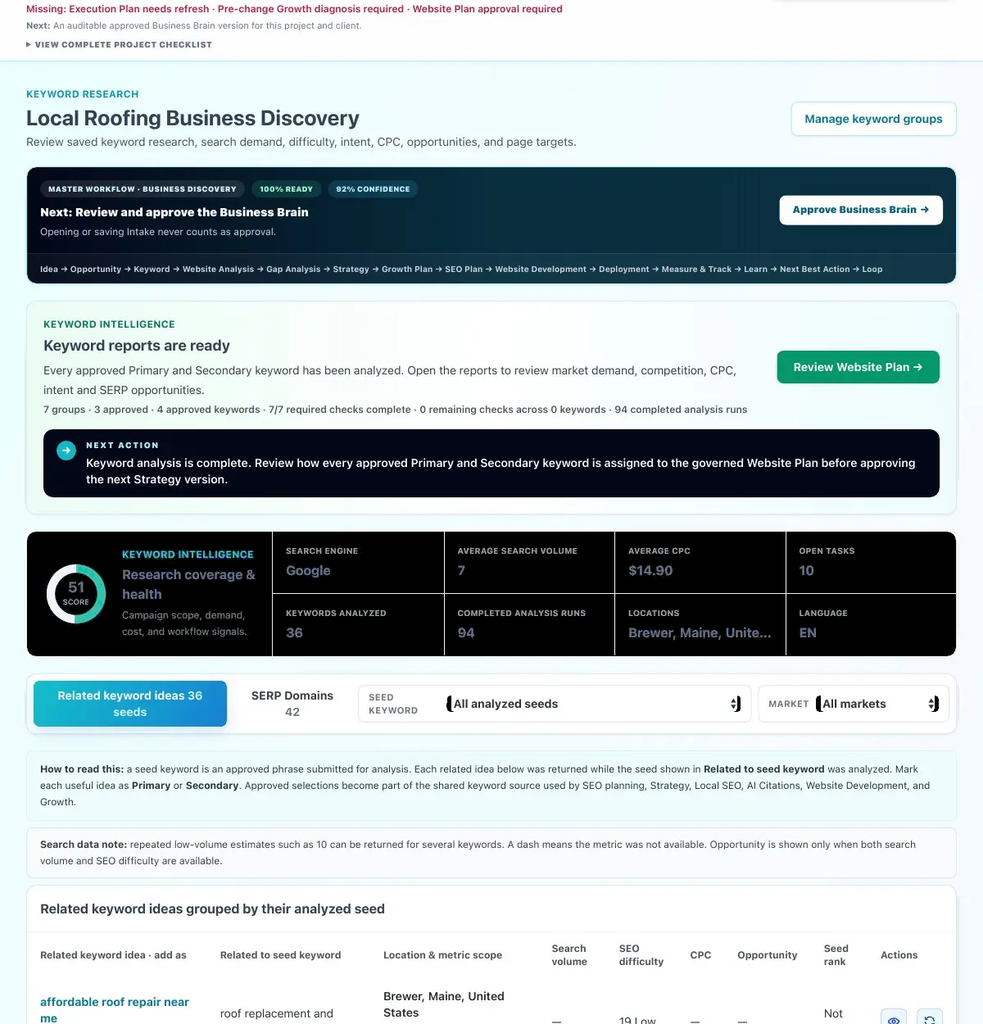
Use case: A new keyword report flags a cluster of high-demand, lower-competition local search terms, and the platform recommends reviewing and approving that keyword plan before any content work begins.
3. Strategy, Execution Plans & the Approval Center
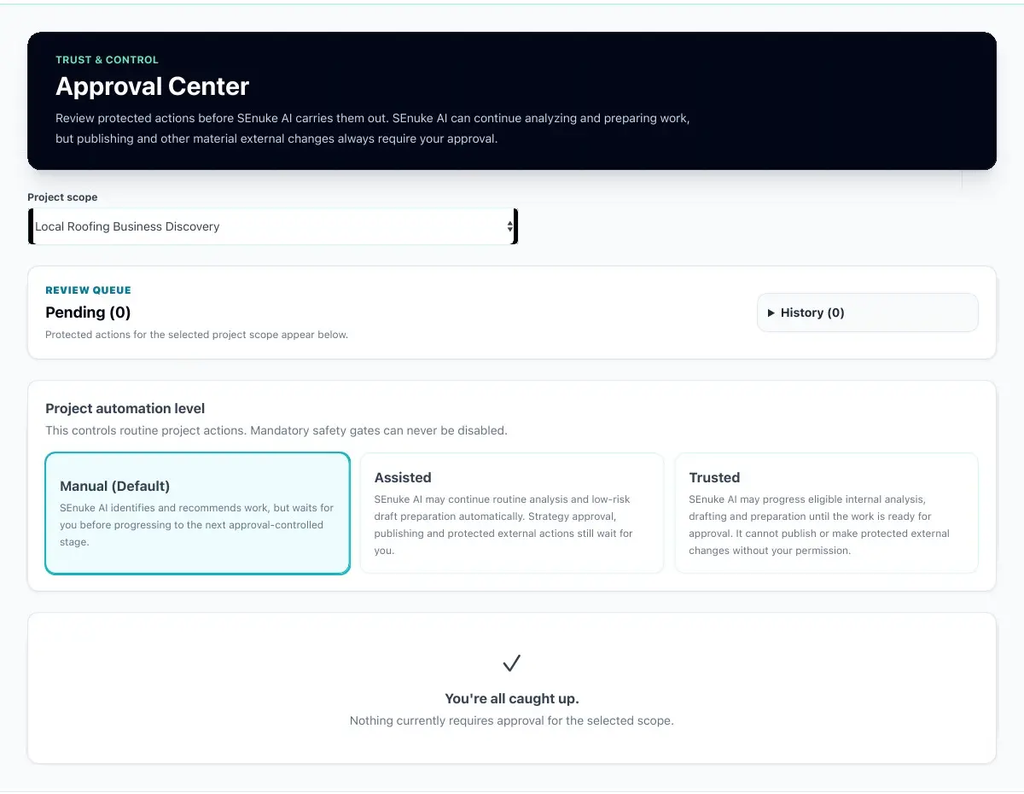
What it does: Once opportunities are identified, SEnuke AI drafts a strategy and breaks it into an execution plan. Nothing sensitive goes live automatically — the platform’s Approval Center requires a human to review and approve proposed actions before they’re carried out, with configurable automation levels (the interface shows options like “Assisted” vs. “Trusted”) and role/permission controls.
Benefits: This directly addresses a common concern with AI marketing tools: losing control over what gets published or changed under your business’s name. Approval stays with the account owner (or authorized team members) rather than the AI acting unilaterally.
Limitations: Because approval is required for material actions, this is not a “set and forget” automation tool—you (or your team) still need to spend time reviewing and approving proposed work, particularly at higher usage volumes.
Use case: SEnuke AI proposes a revised content strategy version (v3 in the platform’s own screenshot) after detecting newer evidence; a human reviews the diff from the prior version and approves it before it moves to execution.
4. Guided Content, Website & Ecommerce Execution
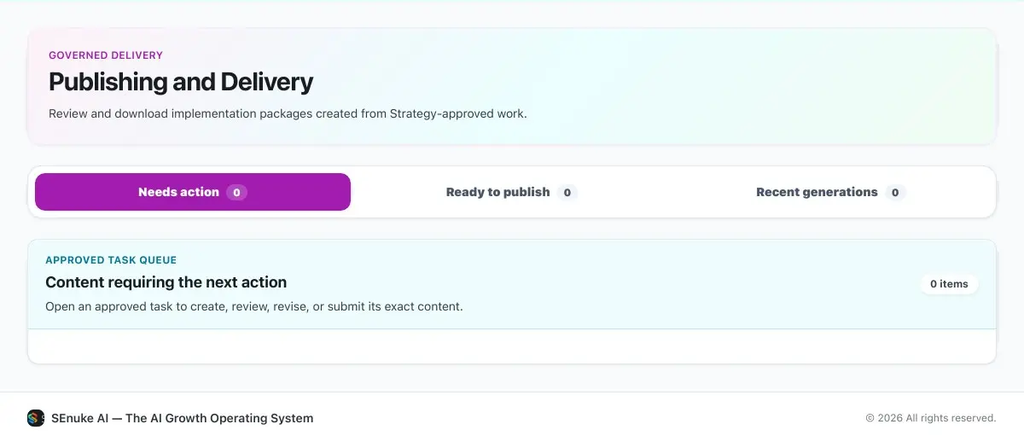
What it does: Once a strategy is approved, SEnuke AI provides guidance and supported execution across content, website changes, lead magnets, social content, and e-commerce—including intelligence for businesses selling on third-party marketplaces.
Benefits: Folding e-commerce and multi-channel guidance into the same system as SEO and content strategy means a seller doesn’t need a separate stack of disconnected tools for each channel.
Limitations: E-commerce intelligence is available on every plan, but direct actions on a store or marketplace (like publishing a listing change or adjusting pricing) depend on supported connections, permissions, and the same approval step—SEnuke AI does not claim to directly control marketplace publishing, repricing, inventory, or fulfillment on your behalf.
Use case: A new online seller uses the e-commerce intelligence layer to identify a marketplace opportunity, then reviews the platform’s execution guidance before making the actual listing changes themselves (or via an approved connection).
5. Measurement, Reporting & the Next Best Action
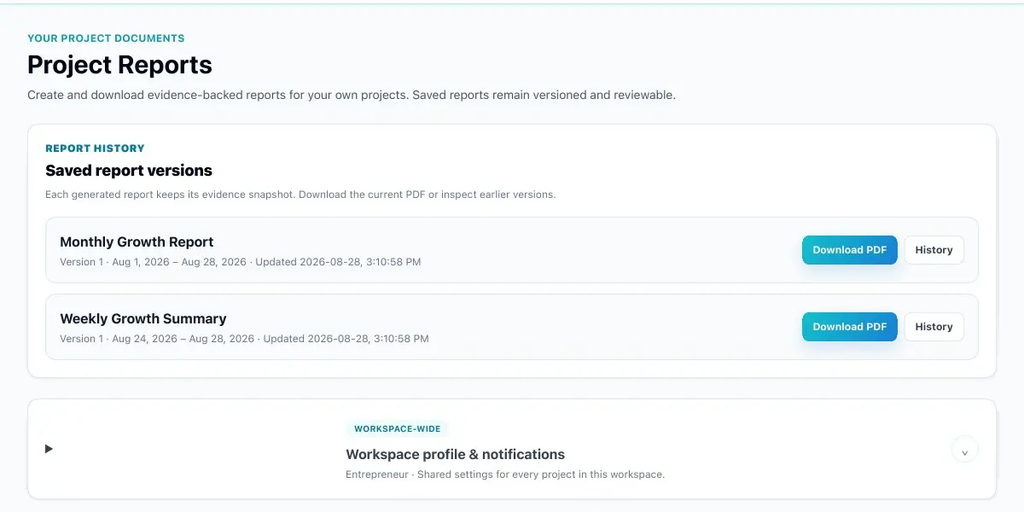
What it does: After execution, the platform measures results and generates reports—the screenshots show a “Project Reports” panel with saved, versioned report history (e.g., “Monthly Growth Report” and “Weekly Growth Summary”) available as downloadable PDFs. That evidence feeds back into the loop to produce the next recommended action.
Benefits: Closing the loop from execution back to a fresh recommendation is the core promise of an “operating system” versus a one-off tool—you’re not left to manually interpret a report and decide what to try next.
Limitations: As with the opportunity scoring, the “Next Best Action” is a prioritized recommendation based on available evidence, not a guaranteed-correct next step—the brief itself is explicit that outcomes aren’t guaranteed.
Use case: A weekly growth summary shows a strategy underperforming its projection; the system logs this and adjusts its next recommended action rather than repeating the same underperforming plan indefinitely.
6. Agency Portfolio & Client Management (Agency Plan)
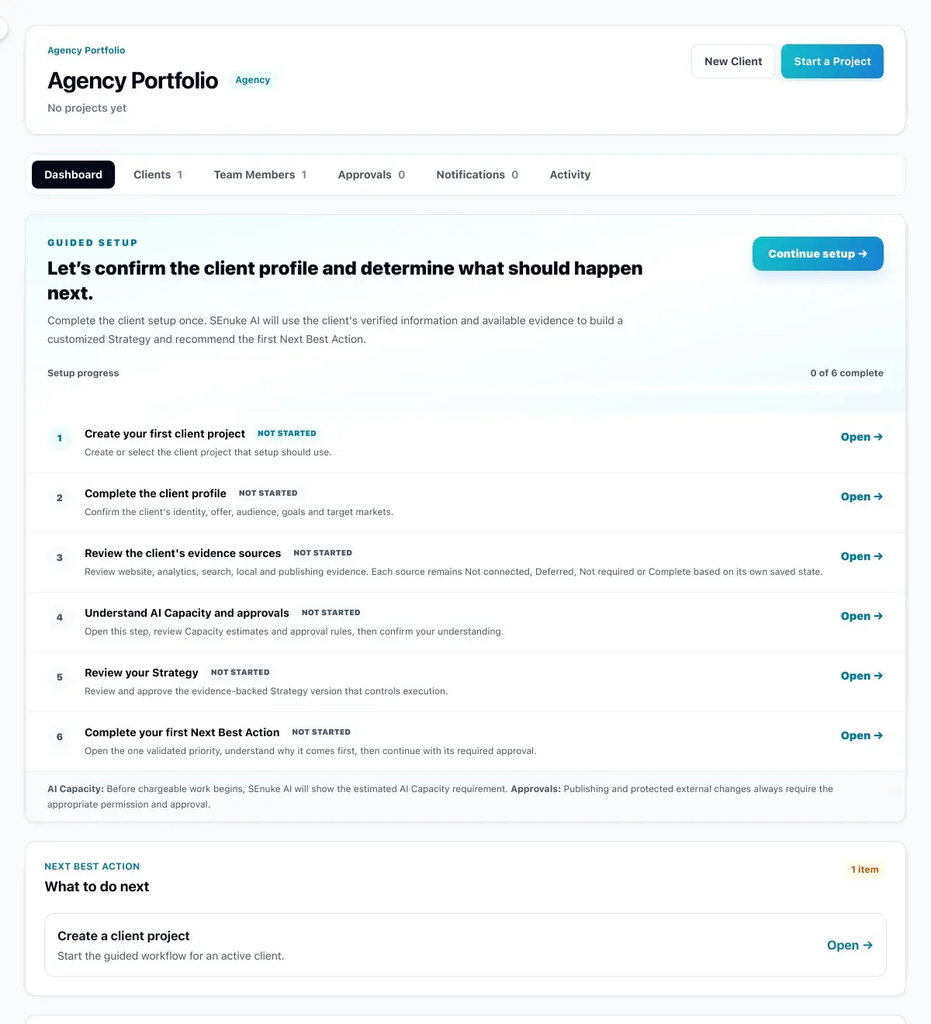
What it does: The agency plan adds a dedicated agency dashboard for managing multiple client projects—starting new client projects, confirming client profiles, and tracking team members, approvals, and activity across a portfolio, with isolated intelligence per client.
Benefits: Agencies and consultants get governed, per-client workspaces plus separate “Agency Client Viewers” (which don’t count against the plan’s 3 internal seats), letting clients see relevant reporting without eating into the agency’s own team seat allowance.
Limitations: At $497/month (or $4,970/year), this tier is a meaningfully bigger commitment than the Entrepreneur or Business plans and is only worth it if you’re actually managing multiple client accounts rather than a single business.
Use case: An agency onboards a new local-business client, completes a guided client profile setup, and gets a client-specific strategy and next best action—separate from every other client in the portfolio.
SEnuke AI User Experience
Note: The observations below are drawn from the platform’s official interface screenshots and the Founding Launch brief since public access opens September 8, 2026. Hands-on details like load speed or edge-case friction will need real-world testing after launch.
Learning Curve
The interface leans heavily on guided workflows—screenshots consistently show a “Best Action” or “Next Action” prompt front and center rather than an open-ended dashboard, which suggests the learning curve is meant to be shallow by design: the system tells you what to look at next rather than requiring you to know where to click. That said, “Growth Operating System” is a broader concept than a single-purpose tool, so expect some initial time investment to understand how Discovery, Strategy, and Approval connect to each other.
Interface Analysis
The screenshots show a consistent set of core screens: a Guided Project Setup and Strategy review area, an Opportunity Intelligence panel with scored insights, a Keyword Intelligence view, an Approval Center for reviewing pending actions, a Publishing & Delivery queue, a Project Reports section with versioned report history, and (on the Agency plan) a separate Agency Dashboard. The consistent visual language—teal action buttons, a left-hand navigation rail, and a repeated “what should happen next” prompt—suggests the UI is deliberately built around the Continuous Growth Loop rather than a generic SaaS dashboard layout.
Onboarding Process
Onboarding appears to start with the guided business discovery flow—the Agency Dashboard screenshot, for instance, shows a “Let’s confirm the client profile and determine what should happen next” prompt as the very first step for a new project. This mirrors the platform’s broader design philosophy of always pointing toward one clear next action rather than a blank workspace.
Required Technical Knowledge
No coding or design skills appear necessary to operate the platform itself—it’s built around guided prompts and approvals rather than manual configuration. That said, business owners should still expect to bring real knowledge of their own business to the discovery step, since the quality of the business brain (and everything built on top of it) depends on accurate input. Agencies will also need to understand client onboarding and permission structures to make full use of the agency plan’s portfolio features.
Support Options
The Founding Launch brief does not publicly detail specific support channels (help docs, live chat, etc.) as of this writing. Buyers evaluating support responsiveness should check the official sales page or JV/Partner HQ directly before purchasing, particularly given this is a recurring subscription rather than a one-time payment.
SEnuke AI Pros and Cons
| ✅ Pros | ⚠️ Cons |
|---|---|
| Connects strategy, execution, and measurement in one continuous loop | Recurring subscription, not a one-time cost ($79–$497/mo) |
| Human approval required before sensitive actions go live | AI Capacity is shared and finite across seats/users on Business & Agency plans |
| Built by an experienced marketing software creator (Joe Russell, since 1999) | No independent, hands-on results yet — platform is pre-launch |
| Every plan includes the full core Growth Operating System | Requires ongoing review/approval, not full hands-off automation |
| Founding price protection while subscription stays active | Founding price isn’t permanent if the subscription lapses |
| Agency plan includes isolated client intelligence and separate client-viewer seats | |
| Covers ecommerce, content, and social — not just SEO |
👉Check out SEnuke AI’s founding launch pricing here
SEnuke AI vs. Alternatives
Main Categories of Alternatives
SEnuke AI’s “AI Growth Operating System” positioning doesn’t map cleanly onto a single competitor category—it overlaps with three different types of tools: traditional all-in-one SEO suites (e.g., Semrush, Ahrefs), general-purpose AI marketing assistants/chatbots (e.g., ChatGPT-based marketing workflows), and agency management/reporting platforms. For a related look at AI-driven marketing tooling on this site, see our best AI marketing tools roundup and our LeadFlux AI review, which covers a different angle on AI-assisted lead generation.
Feature Comparison at a Glance
| SEnuke AI | Traditional SEO Suites | General AI Chat Assistants | |
|---|---|---|---|
| Core model | Guided operating system with an approval loop | Dashboards of separate research/tracking tools | Prompt-in, answer-out |
| Connects strategy → execution → measurement | Yes, by design | Typically manual, tool-to-tool | No—requires manual orchestration |
| Human approval on sensitive actions | Built-in Approval Center | N/A (mostly non-executing) | No built-in governance |
| Ecommerce intelligence | Included on every plan | Varies by suite/add-on | Not built-in |
| Agency/client portfolio structure | Included on Agency plan | Some suites offer agency tiers | No native structure |
| Pricing model | Recurring subscription ($79–$497/mo) | Recurring subscription, typically similar range | Free subscription, general purpose |
Unique Advantages of SEnuke AI
- The approval-gated execution loop is the clearest differentiator. Most SEO suites hand you dashboards and reports and stop there; most AI chat tools generate content or answers without any structured, business-specific priority system behind them. SEnuke AI’s Continuous Growth Loop is explicitly built to bridge that gap.
- One business brain across every function. Rather than re-explaining your business context to a keyword tool, then a content tool, then a reporting tool, the persistent business brain is meant to carry that context through the whole loop.
- Agency-specific governance — isolated per-client intelligence plus separate client-viewer seats is a more purpose-built agency structure than a general SEO suite retrofitted with an “agency tier.”
When to Choose Each
Choose SEnuke AI if you want one connected system that moves from research to strategy to approved execution to reporting, and you’re comfortable with a recurring subscription and a human-in-the-loop approval step for sensitive actions.
Choose a traditional SEO suite if you specifically need deep, mature keyword/backlink/technical SEO data and don’t need the strategy-to-execution-to-reporting loop built in—you’re comfortable doing that orchestration yourself.
Choose a general AI chat assistant if: Your needs are ad hoc (drafting one piece of content, answering one strategy question) rather than an ongoing, structured growth process.
SEnuke AI Review: Final Verdict
SEnuke AI is making a genuinely different pitch than most AI marketing launches: instead of “Here’s another AI tool that generates output,” it’s positioning itself as the connective layer between business understanding, strategy, approved execution, and measurement—the Continuous Growth Loop. Coming from Joe Russell, whose original SEnuke software has a long history in the SEO automation space, this isn’t a brand-new, unproven name, even though SEnuke AI itself is a genuinely new platform rather than a simple relaunch.
What stands out most in the official materials is the deliberate emphasis on human approval—the Approval Center, configurable automation levels, and role/permission controls are clearly meant to reassure buyers that this isn’t an autonomous agent making unsupervised changes to a live business. That’s a meaningful distinction worth taking at face value, given how explicitly the company’s own public claim rules rule out describing it as a chatbot or uncontrolled agent.
Our recommendation: If you’re a solo entrepreneur trying to find or validate a business direction, a small business owner tired of juggling disconnected marketing tools, or an agency looking for a more structured way to manage multiple clients’ growth work, SEnuke AI’s Founding Launch pricing is worth evaluating—especially since annual plans lock in 12 months for the price of 10, and the Founding price stays protected as long as your subscription stays active. Just go in with clear eyes: this is a recurring subscription for a pre-launch platform, not a one-time-purchase tool with an established, independent track record yet, so budget and expectations should be set accordingly.
If the connected strategy-to-execution-to-reporting loop is the piece your current stack is missing, this is worth a closer look before the Founding Launch window closes on September 15, 2026 at 11:59 PM ET.
Ready to see the AI Growth Operating System for yourself?
👉Check out SEnuke AI’s founding launch pricing here