

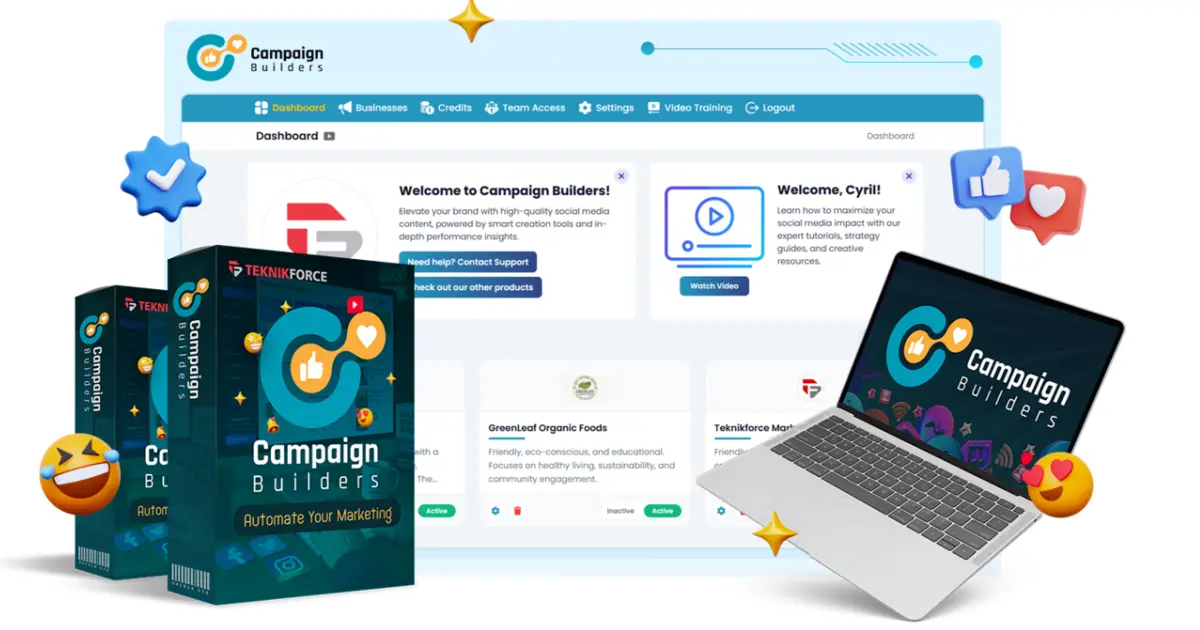
If keeping up with daily social media content ads, memes, graphics, video, and audience replies—feels like more than one person can realistically manage, that’s the exact problem CampaignBuilders is built to solve. It’s a new multi-agent AI marketing platform from Teknikforce, where several AI “specialist” agents work together to plan and produce marketing content automatically, instead of you prompting one chatbot for every single task.
This review covers what CampaignBuilders actually does, what it costs across its full funnel, and who it’s realistically a good fit for based on the official launch materials, demo video, and the vendor’s track record, since the product is not yet publicly available to test hands-on.
Affiliate disclosure: This page contains affiliate links. If you buy through them, I may earn a commission at no extra cost to you.
For more AI marketing and lead-gen software reviews, see our complete 2026 roundup.
Quick Verdict
Overall: A legitimate, well-backed launch from an established vendor, built around a genuinely different approach (multi-agent orchestration) rather than a single AI content generator. Best for: Solopreneurs and small teams who need consistent daily social content without hiring or managing a full marketing team. Biggest strength: Multiple specialized AI agents collaborating on a task, rather than one general-purpose AI trying to do everything. Biggest weakness: The front-end tier (Elite) excludes the “advanced AIs,” meaning the more capable version of the product sits behind an upgrade—evaluate the real front-end limits before assuming you’re getting the full experience from the base purchase. One-sentence recommendation: If you’re already comfortable with AI marketing tools and want to test a genuinely different multi-agent approach, the front-end is a low-risk way to start — just go in expecting the core upgrade (Pro) to be close to necessary for serious use.
What Is CampaignBuilders ?

CampaignBuilders is an AI marketing automation platform built around multi-agent orchestration rather than one AI model generating content on request, multiple specialized AI agents are assigned distinct roles (similar to job functions on a real marketing team), and they collaborate, critique each other’s output, and execute complete campaigns with reduced manual input.
Creator: Teknikforce, led by Cyril Gupta, a long-running software company in the digital marketing space with a track record going back well over a decade. Past Teknikforce products include CloudFunnels, Webira, Blogi, Callsi, and Cohortia, among others, with a stated user base of over 100,000 people across their product line.
Who it’s designed for: Solopreneurs, small business owners, freelance marketers, and agencies who need ongoing social content (posts, ads, graphics, video, audience engagement) without the cost of a full marketing team.
Pricing and access: CampaignBuilders launches with a front-end price of $47 (CampaignBuilders Elite), with a lifetime-access model offered only during the launch window. After launch, the vendor has stated the product moves to standard monthly/yearly recurring pricing—meaning the lifetime deal is a genuine launch-only window, not an evergreen option.
Verified vs. vendor claims: Everything above is stated directly in the official launch and affiliate materials. Claims about specific output quality, campaign performance, or time savings come from the vendor’s own demo and marketing copy treat those as claims to verify yourself during the product’s refund window, not confirmed outcomes.
→ See CampaignBuilders Pricing & Launch Offer →
Key Features
Multi-Agent Marketing Orchestration
What it does: Deploys multiple AI agents with distinct assigned roles that work together on a single campaign, rather than one general AI handling every task in isolation. User benefit: In theory, closer to how a real marketing team divides labor—trend research, content creation, and execution are handled by different specialized processes rather than one prompt trying to do everything. Limitation: Multi-agent AI systems are newer and less battle-tested than single-model content tools; output quality and coordination reliability should be verified firsthand rather than assumed from demo footage. Real-world use case: A solo founder wanting daily content across multiple formats (posts, ads, graphics) without manually directing every individual piece.
Trend Discovery & Content Creation
What it does: Scans for trending topics and news, then generates content built around what’s currently relevant. User benefit: Reduces the research time spent figuring out what to post about. Limitation: Trend-based content tools are only as good as their source data freshness—verify how current the trend detection actually is once you have access, rather than assuming real-time accuracy from marketing copy alone. Real-world use case: Staying visible during news cycles or trending conversations relevant to your niche without manually monitoring multiple platforms yourself.
Ads, Memes & Graphics Generation
What it does: Produces visual marketing assets — ads, memes, infographics — automatically. User benefit: Removes the need for separate design tools or a hired designer for routine social graphics. Limitation: AI-generated visual content quality varies significantly by tool and niche; this is one of the most important things to verify with your own use case before upgrading tiers. Real-world use case: A small e-commerce brand needing a steady stream of promotional graphics without a design budget.
Audience Engagement & Customer Response Generation
What it does: Generates responses to audience engagement and customer questions. User benefit: Reduces time spent on routine audience interaction. Limitation: Automated customer-facing responses carry real reputational risk if unreviewed—this is a feature worth testing carefully before turning on autopilot for public-facing accounts. Real-world use case: A business fielding repetitive audience questions across social platforms who wants a first-pass response system, reviewed before publishing.
Video Content Creation
What it does: Produces video content as part of the campaign output. User benefit: Adds video to the content mix without separate video production tools or skills. Limitation: The launch materials don’t specify video length, style limitations, or platform-specific formatting in detail—confirm these specifics directly before assuming it covers your exact video needs. Real-world use case: Businesses wanting a video presence on top of static content without a dedicated video editor.
What the Demo Shows (Pre-Launch Assessment)
Since CampaignBuilders has not yet launched publicly, this section reflects what’s shown in the official demo video and materials — not independent, hands-on testing. The demo emphasizes agents visibly “discussing” and dividing tasks in something resembling a live collaboration view, which is the core differentiator being marketed. Whether that translates into meaningfully better output than existing single-AI tools is the central thing to verify once real user access and reviews become available—I’d recommend checking early buyer feedback in the first few days after launch before committing to any upgrade beyond the front-end.
Pros and Cons
Pros:
- Backed by an established vendor (Teknikforce) with a long product history and a large existing user base—lower “vendor disappears” risk than a brand-new, unknown creator.
- A multi-agent approach is a genuine architectural difference, not just a rebrand of existing single-AI tools.
- Lifetime access is available, but only during the launch window—a real cost advantage if you’re confident you’ll use it long-term.
- Covers a wide range of content types (text, graphics, video) in one platform rather than needing separate tools.
Cons:
- The front-end (Elite) tier explicitly excludes “advanced AIs” — the more capable version sits behind the Pro upgrade, so front-end buyers should expect a reduced experience, not the full product.
- Multi-agent AI orchestration is a newer approach industry-wide; output consistency should be verified against your specific niche rather than assumed from demo footage.
- Commercial license and the full posting/campaign limits are gated behind Pro ($67) — solo users on Elite are capped at 15 ads/day and 4 campaigns.
- After the launch window, the product moves to recurring monthly/yearly pricing — the lifetime option won’t be available if you miss the launch.
CampaignBuilders vs. Alternatives
CampaignBuilders competes broadly with single-AI marketing content tools (AI copy/graphics generators) and full social media management suites (scheduling + content in one platform).
Vs. single-AI content generators: CampaignBuilders’ multi-agent approach is meant to reduce manual prompting compared to tools where you individually direct one AI per task. If you’re already comfortable prompt engineering a single AI tool effectively, the practical benefit of multi-agent orchestration may be smaller for your workflow specifically than the marketing suggests.
Vs. full social media management suites: Established suites often have more mature scheduling, analytics, and multi-platform publishing track records, since they’ve been refined over years of real user feedback. CampaignBuilders is newer and leans more heavily on content generation than on scheduling/analytics maturity — if deep analytics is your priority, compare feature-for-feature before switching.
Where an alternative may genuinely be the better choice: If you already have a content workflow you’re happy with and just need better scheduling or analytics, an established social media suite may serve you better than switching platforms for a content-generation upgrade.
Is CampaignBuilders Worth It?
Price-to-value: At $47 for the front-end, the entry cost is low relative to hiring even part-time marketing help—but the front-end’s exclusion of “advanced AIs” means the realistic cost of the full experience is closer to $47 + $67 (Pro) for most serious users.
Time savings: The core value proposition is time saved on content creation and posting—real, but unverifiable in exact hours until you or independent reviewers have hands-on access.
Refund policy and free trial: Confirm the specific refund window directly on the sales page before purchasing, since this wasn’t detailed in the affiliate materials—don’t assume a guarantee exists until you’ve verified the exact terms at checkout.
ROI: Reasonable to expect time savings on routine content tasks; unreasonable to expect guaranteed follower growth, sales, or engagement increases from any content-automation tool without your own product-market fit already in place.
Who Should Buy It and Who Shouldn’t
Best for:
- Solopreneurs and small business owners needing consistent daily social content without hiring
- Agencies wanting to test AI-assisted content production for client work (commercial license available on Pro)
- Users already comfortable evaluating AI tool output critically, rather than expecting fully hands-off perfection
Not recommended for:
- Anyone expecting guaranteed sales or growth results purely from content automation
- Businesses in highly regulated industries where unreviewed AI-generated customer responses carry compliance risk
- Buyers unwilling to budget for the Pro upgrade, since the front-end’s advanced-AI exclusion is a real limitation
What you’ll need: A clear sense of your niche and offer (the tool amplifies content output; it doesn’t replace product-market fit), a budget that realistically includes the Pro upgrade if you want the full feature set, and time in the refund window to verify output quality against your specific use case.
Final Verdict
CampaignBuilders is a legitimate launch from an established vendor with a real track record, built around a genuinely different multi-agent approach rather than a repackaged single-AI tool. The front-end is a reasonable, low-cost way to test that approach, but go in with clear eyes: the more capable version of the product sits behind the Pro upgrade, and the multi-agent output quality is the one thing worth verifying yourself in the refund window rather than taking on faith from demo footage.
Who should buy: Solopreneurs and small teams comfortable evaluating AI output critically who want to test a multi-agent approach to marketing content. Who should pass: Anyone expecting guaranteed business results from content automation alone or unwilling to budget beyond the front end for the full feature set.
→ See CampaignBuilders Pricing & Launch Offer →
CampaignBuilders FAQ
What Is CampaignBuilders?
An AI marketing platform from Teknikforce that uses multiple specialized AI agents working together to create and manage marketing content, including ads, graphics, video, and audience responses.
How Much Does CampaignBuilders Cost?
The front-end (Elite) is $47, with a Pro upgrade at $67 that unlocks advanced AIs, higher posting limits, and a commercial license. Lifetime access is available only during the launch window.
“For the full breakdown of every upgrade, see my CampaignBuilders OTO Exposed guide.”
Is CampaignBuilders a Legitimate Product?
Yes. It’s created by Teknikforce, an established software company with a multi-year track record and a large existing user base across prior products.
Does CampaignBuilders include a commercial license?
Commercial licensing is included with the Pro upgrade, not the front-end Elite tier.
What Happens After the Launch Window Closes?
CampaignBuilders moves to standard monthly/yearly recurring pricing after launch — the lifetime access option is only available during the initial launch period.